
On Friday, May 23, 2025
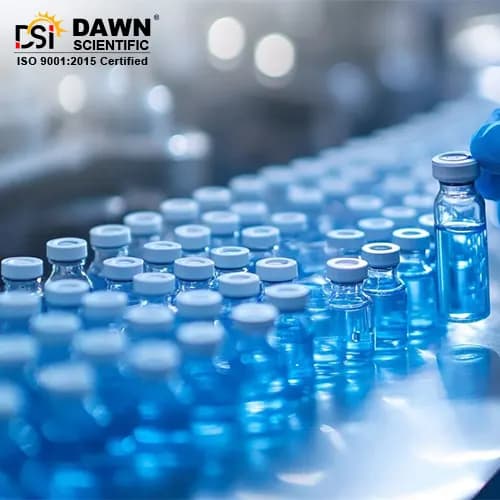
In contemporary analytical labs, precision, reproducibility, and sample integrity are not negotiable. Yet, most labs ignore a crucial element that can have a considerable impact on these results—autosampler vials. At Dawn Scientific, we know that precision begins with the smallest details. It is because of this reason that the choice of customized autosampler vials is the most important for ensuring optimal analytical results. We shall be addressing Why Autosampler Vials Matter in Analytical Workflows, aspects of the choice of appropriate autosampler vials, Uses of GC vials and LC-MS vials, advantages of vial optimization, and Dawn Scientific as an autosampler vial provider in this blog article.
From mass spectrometry to chromatography, the success of your autosampler is highly dependent on the compatibility and quality of your vials. Suboptimal choice of vials may cause sample evaporation, contamination, loss of volatile analytes, or instrument faults.
Optimizing your procedure with autosampler vials optimizes your workflow to:
Glass autosampler vials are the most appropriate for most applications due to their chemical resistance and low extractable levels. We market borosilicate glass vials at Dawn Scientific that provide sample purity and minimize the risk of interaction with analytes.
But in case of delicate biological samples or if working with extremely adsorbing compounds, plastic vials such as polypropylene are even more suitable due to their surface activity being less.
Proper cap and septa pairing is critical for sample integrity, leak prevention, and contamination prevention. Choices include:
Crimp top, screw cap, or snap cap? Choose based on your autosampler model and application. Crimp caps provide a tighter seal, whereas screw caps offer convenience and reusability.
For most HPLC and GC systems, 1.5 mL or 2 mL vials are standard. Yet, when sampling small volumes, low-volume inserts or micro vials are preferred.
Protect light-sensitive samples with amber vials that block destructive UV light. Use transparent vials for visual samples and for QC alone.
With individually chosen vials to address your individual application, you can anticipate:
As a reputable supplier of analytical laboratory equipment, Dawn Scientific offers full line-ups of autosampler vials, septum caps, and inserts for HPLC, LC-MS and GC applications. Our offerings include:
We can also assist with technical advice to select the optimum vial size for your instrument, sample type, and analysis.
You don’t need to make drastic changes to optimize analytical results in all cases—sometimes it is as simple as starting with the smallest part. With customized autosampler vials, you reduce errors, protect your samples, and ensure your data is of the highest quality.
At Dawn Scientific, we work hard to provide not just products, but solutions to help your lab run at its best. Learn about our full range of autosampler vials and speak with our personnel for advice specific to your requirements.