On Saturday, April 4, 2026
A group of researchers headed by Professor Ken Motokura of Yokohama National University has come up with a breakthrough catalytic process that allows the α-allylations of simple ketones with allyl alcohols. The study, which was published in ACS Catalysis, tackles a persistent problem in organic chemistry caused by the poor reactivity of allyl alcohols and simple ketones.
The allylation is an important reaction that is done to add an allyl group to molecules and is common in the production of pharmaceuticals and agrochemicals. However, direct allylation with less reactive substrates has remained difficult.
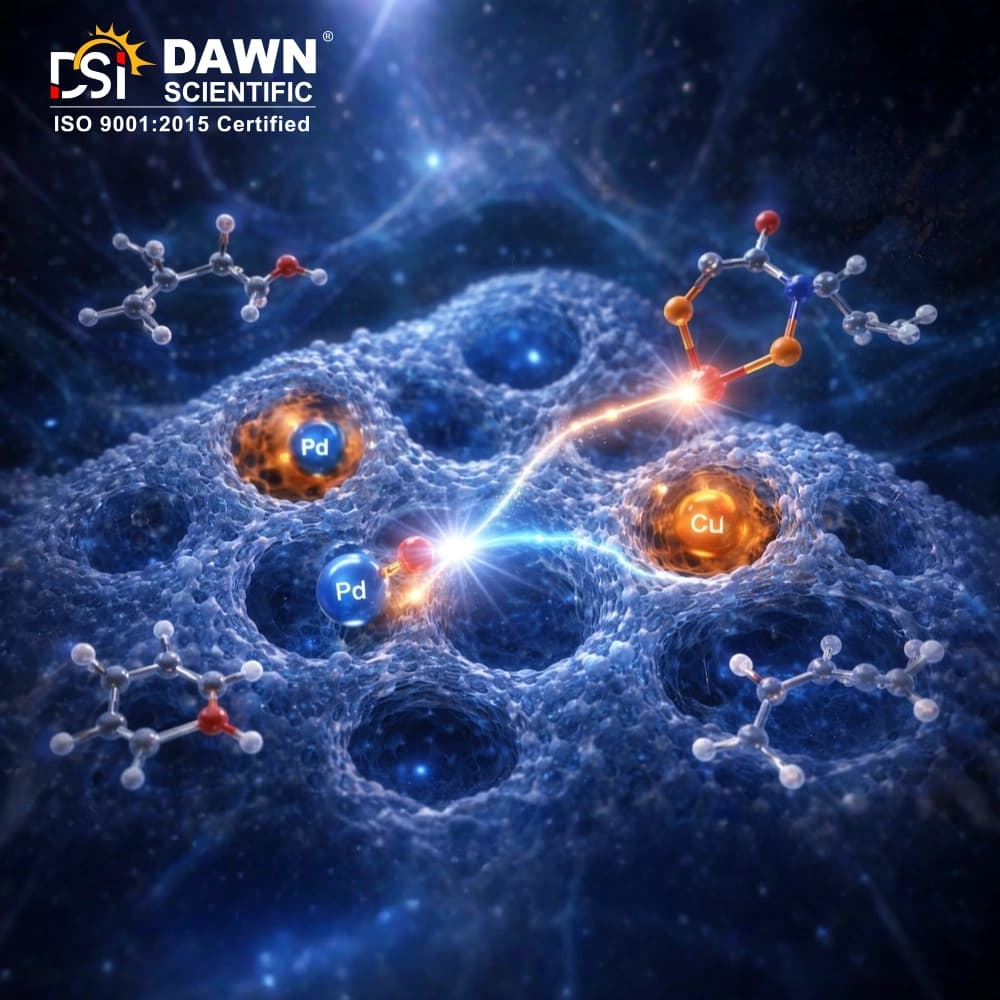
In order to overcome this, Motokura and his group consisting of Shunichi Sakai and Shingo Hasegawa designed a multifunctional catalyst using a mixture of catalytically active species overlaid on mesoporous silica. This system is a complex of palladium and copper that allows activating ketones and allyl alcohols at the same time. Organic functional groups also help in increasing efficiency by optimizing active sites.
The catalyst was 15.5 times more active than the traditional systems were. The enhancement of this is due to the spatial concentration of active sites, which enhances cooperative catalysis. Also, recycling experiments revealed that the catalyst is easy to isolate and reuse with good performance.
The design of the catalyst in this work represents a novel strategy compared to the conventional approaches to the problem such as the choice of metals or the design of the ligands, representing a scaled-up strategy to complex chemical transformations.
We at Dawn Scientific, enable these innovations by providing high quality laboratory chemicals and reagents needed in the advanced research. Developments like this highlight the growing importance of reliable materials in enabling efficient and sustainable chemical synthesis.
Disclaimer: All the information on this news is published in good faith and for general information purposes only. The information contained in this news might be provided on an “as is” based on Wikipedia, Google, and other scientific articles. We are not liable for any injuries or damages for the use of the information. Please do your own research before you use this information for any purpose.


