On Saturday, October 4, 2025
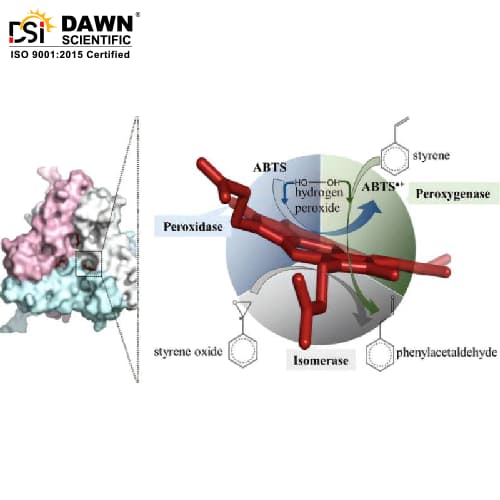
Scientists from Ruhr University Bochum, working in partnership with Delft University of Technology, have achieved a breakthrough in discovering the mechanism by which the enzyme styrene oxide isomerase produces the useful chemical phenylacetaldehyde from toxic styrene oxide. The research, appearing in ACS Catalysis (2025), shows that the active site of the enzyme has iron-based heme and two critical amino acids—tyrosine and asparagine—that are fixed in just the right position to catalyze the unusual Meinwald rearrangement. The researchers showed that the tyrosine functional group is essential for the reaction. The catalytic function of styrene oxide isomerase was previously a hypothesis, but the present study offers the first experimental evidence for its molecular mechanism. The enzyme is not specific to styrene degradation—it also has the potential to detoxify hydrogen peroxide and form phenylacetaldehyde directly from cheap styrene. Although at the moment these other functions are less efficient, their versatility and flexibility pave the way for future industrial use. Researchers dream that further development of this enzyme can enable it to become possible to synthesize high-value chemicals from low-cost raw materials in a sustainable way, a new frontier in the field of biocatalysis.
At Dawn Scientific, we are committed to providing the newest scientific advancements, reagents, and laboratory solutions to researchers across the USA. Being a woman-owned, ISO-Certified company, we promote advancement in microbiology, biotechnology, and chemistry research through providing better chemicals, stains, indicators, and lab essentials. Our goal is to provide chemists, scientists and educators with what they need in an attempt to move research and innovation forward.
Disclaimer: All the information on this news is published in good faith and for general information purposes only. The information contained in this news might be provided on an “as is” based on Wikipedia, Google, and other scientific articles. We are not liable for any injuries or damages for the use of the information. Please do your own research before you use this information for any purpose.