On Friday, December 26, 2025
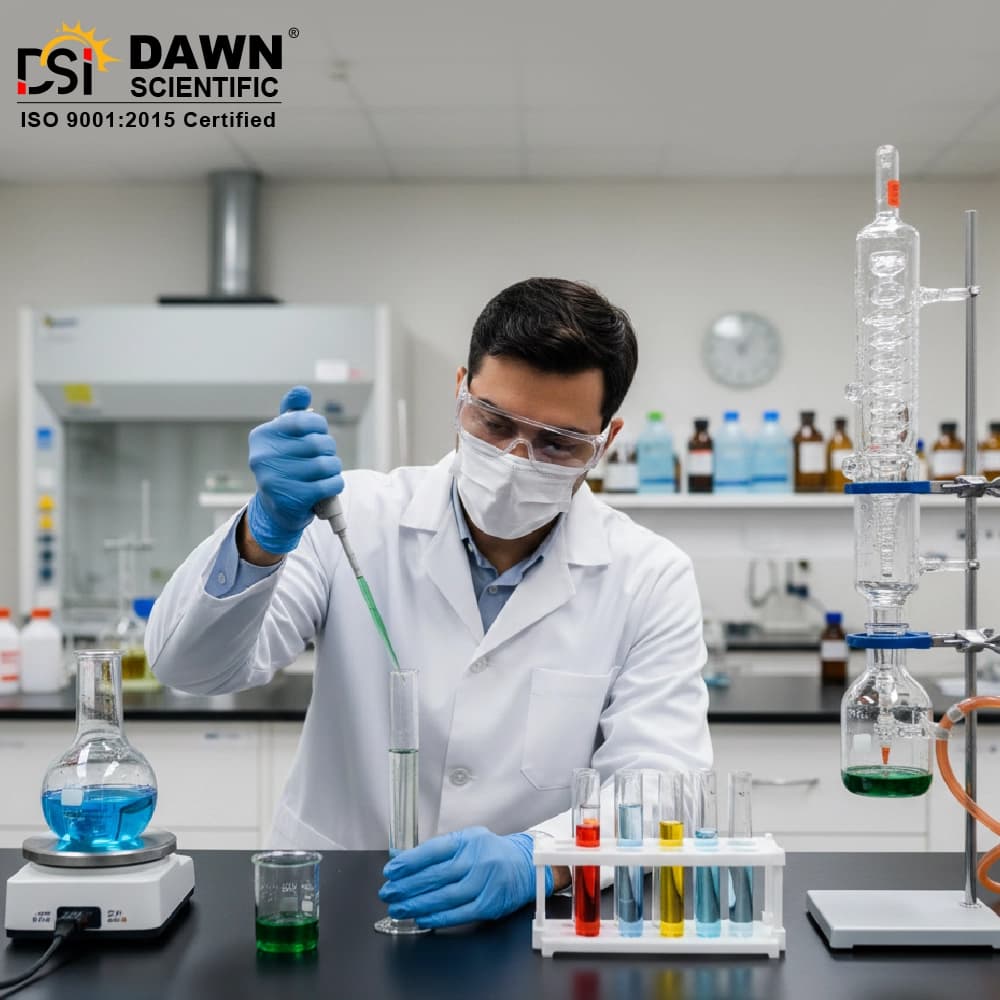
The accuracy of the outcomes in any scientific setup, be it a pharmaceutical production plant, a research and development laboratory, an analytical testing facility, or a college laboratory, is strongly associated with the quality of the chemical reagents employed. In the case of the U.S. laboratories that need accuracy and regulatory compliance, High-Purity Chemicals are essential. These chemicals are controlled in terms of impurities and purity, consistency is verified, and the grade is certified, thus putting a reliable basis on every experiment.
This manual offers a new, detailed overview of High-Purity Chemicals, their grades, and the key applications of High-Purity Chemicals, as well as an opinion on how to choose the right High-Purity Chemicals for research, a query that is often posed by lab professionals.
A high-purity chemical is a chemical that has been purified by a rigorous set of purification procedures meant to remove impurities, including water, heavy metals, and organic compounds, as well as ions and particulates. The allowed impurity is dependent upon the grade of the chemical and the intended purpose. The purity is ensured by means of modern types of analysis, such as ICP-MS, HPLC, GC-MS, titration, and spectroscopy.
In comparison to general laboratory chemicals, the High-Purity Chemicals provide reproducibility and precision. This is the reason why scientists typically go to the internet to locate what are High-Purity Chemicals used for in laboratories, particularly when standard operating procedures are developed or when acquiring a reagent to be used in a sensitive application where results are absolutely reliant on chemical integrity.
The knowledge of the most prevalent grades will assist in making the right choice regarding your chemical requirements. The following are the key categories that are applied in the entire United States.
Definition:These ACS Grade chemicals have a high standard that is set by the American Chemical Society. Reagent grade chemicals also have high purity, but do not guarantee ACS standards compliance.
Purity Level:Usually 95-99.9%, with controlled impurity levels.
Applications:Analytical chemistry, Titrations, Standard preparations, Academic research, Method development
This grade is necessary in the workflows where any slight levels of impurity may lead to the integrity of data being compromised.
Definition: These chemicals are created to match the requirements of High-Performance Liquid Chromatography and provide remarkable UV-transparency and low levels of particulate matter.
Purity Level: Ultra-high sensitive detection.
Applications: HPLC and UHPLC, LC–MS, Purity profiling by chromatography, Research QC testing
The use of non-HPLC solvents may destroy columns, introduce baseline drift, and fail in the identification of false peaks.
Definition: Prepared according to the requirements in the United States Pharmacopeia (USP) and National Formulary (NF).
Purity Level: High, with particular safety, toxicity, and composition limits.
Applications: Drug formulation, Processing of active pharmaceutical ingredients (APIs), Nutraceuticals, and food manufacturing.
Definition: Optical and UV-based analytical methods.
Purity Level: Very low absorbances and high optical clarity.
Applications: UV/Vis spectroscopy, Fluorometry, Instrument calibration, Standard preparation of high precision.
The purity of chemicals is high and enables the predictability of reactions and the correct calculation of molarity. The researchers wishing to know what are High-Purity Chemicals used for in laboratories will find that R&D is dependent on accurate reagent composition so that experiment integrity can be preserved.
QC laboratories are tightly regulated by the FDA and cGMP. There is no choice when it comes to using USP/NF and HPLC Grade chemicals. They assist in the provision of product safety, consistency, and compliance.
In the analysis of contaminants in air, water, or soil, the contamination of the reagents can easily give a false positive outcome. The importance of purity in scientific research is particularly apparent in environmental laboratories, where precision is paramount to regulatory documents.
Whereas teaching labs can utilize cheaper grades, superior academic research needs the use of the ACS or HPLC grade reagents in order to obtain reliable data.
The main considerations are the following:
An incorrect grading may result in damage to the instruments, inaccurate analysis, or even regulatory problems.
The question that scientists tend to pose is why purity matters in scientific research, and the answer is straightforward:
Reliability is directly proportional to purity. Even minute impurities will cause:
The purity of chemicals ensures your investment, your research, and your reputation.
Depending on the laboratory testing requirements during the establishment of new workflows, the labs often seek where to purchase high-purity chemicals or even compare alternatives to identify the best place to buy High-Purity Chemicals in the USA. By selecting a reliable supplier, it can be certain that there will be quality, speed, and purity.
In case you are in need of the USA's leading supplier of high-purity chemicals, Dawn Scientific is the best choice. We are a reliable supplier to the U.S. and supply certified ACS grade, Reagent Grade, HPLC Grade, USP/NF Grade, and spectrophotometric-quality chemicals, which are supported by strict quality control.
Be it is to streamline a chromatographic technique or carry out routine QC tests, Dawn Scientific can make sure that all the bottles are of the desired purity levels. When laboratories provide the query Where to buy High-Purity Chemicals for laboratory testing, Dawn Scientific is the solution to the query of thousands of researchers throughout the country.
Disclaimer: All the information on this blog is published in good faith and for general information purposes only. The information contained in this blog might be provided on an “as is” based on Wikipedia, Google, and other scientific articles. We are not liable for any injuries or damages for the use of the information. Please do your research before you use this information for any purpose.