
On Friday, July 4, 2025
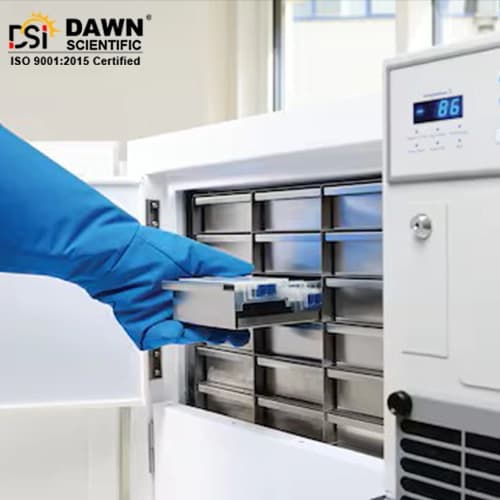
In all contemporary laboratories, -80 °C freezers are a must to store temperature-sensitive materials like enzymes, DNA, RNA, proteins, cell cultures, and reagents. To guarantee the safety and integrity of these samples, however, high-performance freezer racks are just as important. The racks not only maintain the physical and chemical integrity of samples but also improve workflow efficiency and extend the life of the freezers.
In this blog, we discuss the vital function freezer racks serve to protect samples within ultra-low temperature freezers and how they can revolutionize lab storage into a better, more efficient space.
There is a need to maintain the internal temperature of a -80 °C freezer to guarantee sample viability. Upon opening a freezer, cold air leaks out and warm air goes in. This temperature fluctuation may destabilize the samples. Freezer racks reduce exposure by allowing quicker access to samples. Organized storage facilitates quicker retrieval, thus the freezer door is open for a shorter time, and the internal temperature is better preserved, as well as reducing compressor stress.
Without racks, a lot of the freezer’s interior space is usually not utilized because samples are stacked inefficiently or not at all. Freezer racks are used to optimize vertical and horizontal space to maximize the overall number of samples that can be safely stored. Freezers are able to extract more from current units as laboratories, thereby postponing investing in new equipment.
By maximizing capacity, racks also enable sustainable practice through preventing energy waste and maximizing freezer usage.
One of the most significant issues in laboratories is accessing the right sample without interfering with others. Freezer racks eliminate this challenge by offering structured, compartmentalized storage. With upright or chest freezers, freezer racks for your type of freezer allow you to more effectively store samples by project, date, or type.
Such an organized system allows lab personnel to retrieve what they need without having to search, lessening the potential for sample contamination or damage and ensuring against human error in inventory control.
At low temperatures, chemicals can crystallize and become brittle and therefore subject to cracking or breaking. Freezer racks provide a firm framework that eliminates tipping over or uncontrolled stacking of boxes. Their use incorporates additional insurance against mechanical stress, resulting in sample damage even when samples are routinely handled.
Along with that, stainless steel freezer racks and aluminum freezer racks are designed to hold up to tough conditions without warping, bending, or rusting— so they’re a secure long-term storage option.
When the power goes out or the freezer fails, having the time to act is more than important. Having a quality freezer rack system means that sets of samples can be pulled and moved into backup storage or dry ice in a matter of minutes. This level of forward thinking can be the line between safeguarding sample data and losing it altogether.
To maximize the benefit of freezer racks in your -80 °C freezer, follow these best practices:
Utilize racks that are freezer-type compatible (upright or chest).
Label everything—racks and boxes, even individual vials.
Never overfill racks, which can damage your samples or impede airflow.
Use dummy boxes to fill vacant rack space and maintain temperature.
Perform regular audits and defrost cycles to maintain freezers in optimal working condition.
Interface inventory systems for the ability to monitor sample location and history.
Yes. Freezer racks allow faster access to samples and limit the duration the freezer door stays open, maintaining the internal temperature better. This reduces the load on the compressor and conserves energy.
Stainless steel freezer racks are very tough, corrosion-proof, and ideal for heavy-duty long-term use. Aluminum freezer racks are light in weight and low-cost and ideal for laboratory applications with adjustable or mobile storage needs.
Definitely. Freezer racks can be built in a variety of configurations that suit box size, vial shape, and freezer model. This maximizes storage space and sample protection.
During emergencies like freezer failure or power loss, freezer racks enable quick removal and relocation of large quantities of samples. This keeps samples out of increasing temperature.
Yes. While it may come across as a luxury, freezer racks are absolutely necessary for ensuring the safety of samples, increasing the efficiency of your lab, and extending the life of your ultra-low temperature freezer.
Freezer racks are more than a matter of organization—while they’re certainly that, they’re also the secret to maintaining scientific sample integrity in -80 °C freezers. From streamlining workflow and optimizing storage to reducing sample exposure and maintaining freezer life, the benefits are obvious.
At Dawn Scientific, we offer an entire range of freezer racks to suit the requirements of any laboratory. Whether you’re equipping a small research lab or running an economy-scale biobank, our storage solution shields your samples from the cold, keeps them organized, and at your fingertips—no matter how cold it gets.