
On Friday, August 7, 2026
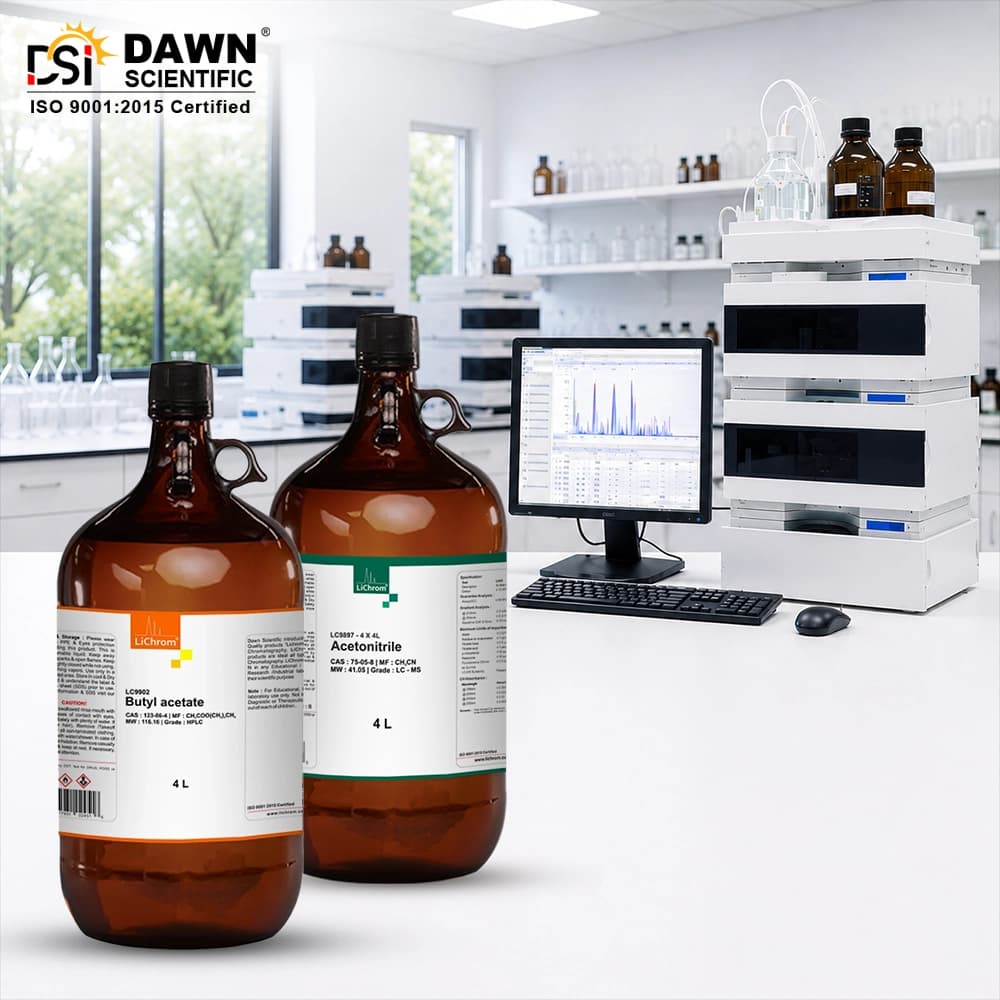
The purity of the solvent is an important consideration in analytical laboratories to obtain good reproducibility and accurate results. The choice of the right grade of solvent is very important for many common practical chromatography or even more sensitive mass spectrometry analyses to ensure instrument performance and quality data.
HPLC grade solvents and LC-MS-grade solvents are some of the most common types of solvents. These solvent grades are similar but vary in terms of sensitivity and analytical needs. Finally, the use of HPLC and LC-MS-grade solvents can help avoid analytical errors, reduce downtime, and improve the reliability of the testing process, which can be beneficial for lab researchers who are aware of these. This guide will provide you with information on the differences, use and importance of the correct solvent to use in the laboratory.
Solvents used in HPLC systems are specially purified. These solvents are produced with a very low level of particulate matter, a low UV absorbance, and a low non-volatile residue. Typical HPLC solvents are: methanol, acetonitrile, water, or isopropyl alcohol.
The main role of the HPLC-grade solvent is to serve as a mobile phase, which will carry the analytes through the HPLC column. HPLC-grade solvents are formulated to minimize detector interference and provide good baseline stability during HPLC analysis, as these detectors are typically used.
Most HPLC solvents are filtered through 0.2 µm or smaller particle filters to prevent particles from clogging HPLC columns or damaging instruments. They also play an important role in reducing solvent contamination, which is crucial for having reliable chromatography results.
LC-MS grade solvents are ultra-pure solvents that are designed for use in Liquid Chromatography-Mass Spectrometry applications. LC-MS grade solvents are further purified and tested to remove solvents or other contaminants that contain ionic compounds and volatile solvents or other impurities that could interfere with the mass spectrometry detection, compared to HPLC grade solvents.
Mass spectrometers are very sensitive analytical instruments, used for the detection of compounds at very low concentrations. Small levels of contamination can generate background noise, ion suppression, or peaks. This is the reason why LC-MS grade solvents are regarded as one of the top high-purity solvents used in analytical laboratories.
Solvent purity requirements are especially important for solvents used in the manufacturing of LC-MS grade products, with an emphasis on excellent baseline quality, low metal ion levels, and solvent contamination. The solvents are commonly used in pharmaceutical testing, environmental analysis, proteomics, and biological research applications.
Solvent purity requirements are especially critical for solvents used in the manufacturing of LC-MS grade products, with an emphasis on excellent baseline quality, low metal ion levels and solvent contamination. The solvents are widely used in pharmaceutical testing, environmental analysis, proteomics, and biological research applications.
HPLC-grade solvents are heavily treated to remove any residual UV-absorbing particles and other impurities. But, solvents used for LC-MS must have even lower levels of trace impurities in solvents, such as alkali metals, phthalates, and volatile organic compounds.
The HPLC systems are mainly used to detect UV absorbance, and the LC-MS instruments detect ions at a trace level. This is why LC-MS solvents are optimized to minimize ion suppression and unwanted background signals due to solvent contamination.
Solvents are stable for basic stability, and LC-MS grade solvents are more reproducible in sensitive mass spectrometry applications. Peak identification and quantification are more accurate using stable baselines.
LC-MS grade solvents are produced to contain very low levels of metal ions, which are known to form adducts in electrospray ionization. This extra purification step is typically not needed for HPLC-grade solvents.
Using the correct solvent grade is essential for maintaining laboratory efficiency and protecting expensive analytical equipment. Solvents of poor quality can cause solvent-related contamination, reduce column life, and have an adverse impact on analytical repeatability.
HPLC grade solvents are suitable for regular use in HPLC applications. But in a highly sensitive mass spectrometry system, LC-MS grade solvents are required to prevent interference by trace impurities in solvents.
Poor quality solvents can also cause erratic baseline and retention times, and higher maintenance costs for the instruments. The use of high-purity solvents that can be relied upon can provide better analytical results and fewer operational issues.
A variety of solvents are available as HPLC-grade solvents and LC-MS grade solvents, such as:
Among these, methanol and acetonitrile are particularly popular, since they are both used for good chromatographic performance and ionization that is effective in LC-MS applications.
The selection of the right high-purity solvents will depend on your analytical method, your type of detector and your level of sensitivity.
High-purity solvents are essential to obtain accurate results in chromatography and mass spectrometry applications in modern analytical laboratories. For highly sensitive workflows, such as those used in laboratories that specialize in biotechnology, environmental testing, food analysis, and pharmaceutical applications, LC-MS grade solvents are ideal; HPLC grade solvents are suitable for routine chromatography applications.
High-quality solvents lead to less contamination of the solvents, more stability of the baseline, and decrease the analytical failure due to contaminants in the solvents.
The quality of solvents is critical to advanced analytical workflows and that's why we understand it at Dawn Scientific. We offer HPLC and LC-MS grade solvents of the highest quality, all of which are laboratory grade to the highest standards of purity, consistency and performance. A large range of high-quality solvents are available for you to use in your pharmaceutical labs, research and development facilities, chemical industries and analytical testing labs. Dawn Scientific has a variety of products available that can help reduce solvent contamination and baseline noise in difficult chromatography applications such as methanol, acetonitrile, water, and specialty chromatography solvents.
If you need reliable HPLC-grade solvents, reliable LC-MS grade solvents or any other chemical, Dawn Scientific is your source for the solutions you need in a modern laboratory.
There are two types of HPLC-grade solvents and LC-MS-grade solvents; each is used in a different context, depending on purity and sensitivity requirements. HPLC grade solvents are suitable for general chromatography use whereas LC-MS grade solvents are required for sensitive mass spectrometry analysis. The use of suitable high-purity solvents minimizes contamination of solvents, improves baseline stability and yields accurate and reliable results. Dawn Scientific is a source of high-quality solvents for laboratory and analytical applications.
Disclaimer: All the information on this blog is published in good faith and for general information purposes only. The information contained in this blog might be provided on an “as is” based on Wikipedia, Google, and other scientific articles. We are not liable for any injuries or damages for the use of the information. Please do your own research before you use this information for any purpose.