On Friday, August 22, 2025
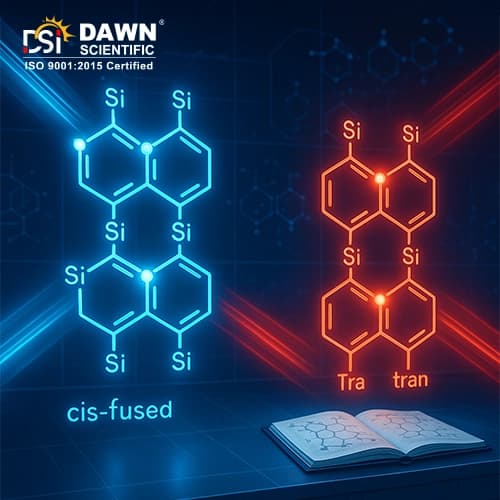
Researchers in the US have pushed the science of organosilicon chemistry further with the creation of a sequence of fused silicon ring six-membered compounds, the next level of sophistication for ladder molecules. The novel molecules, which were formed by the reaction of a silicon dianion with the tetrasubstituted cyclohexasilane ring, are characterized as “among the most complex organosilanes synthesized” by virtue of their numerous rings and stereogenic centers.
Ladder molecules derive their name from their parallel atomic chain architecture joined together by “rungs,” like a ladder. Organic ladder systems such as ladderanes have been thoroughly documented in natural lipids, yet silicon-based analogs have been uncommon, with only less complex four-membered ring fusions being reported since the 1980s.
In this discovery, the group headed by Rebekka Klausen at Johns Hopkins University synthesized bi- and tricyclic silicon ladders that change in stereochemical configuration based on reaction conditions. Importantly, the stereochemistry of these molecules greatly affects their optical properties. Trans-fused silicon ring compounds absorb light at longer wavelengths than their cis-fused ring counterparts, an effect due to higher electron delocalization across the expanded silicon framework.
This thermodynamics-stimulated insight into stereoselective assembly of ladder molecules promises windows to design custom silicon-based chromophores for upcoming materials and optoelectronics. The findings point toward the increasing maturation of silicon chemistry and its promise in next-generation molecular electronics and photonics devices.
For the laboratories that desire reliable products, Dawn Scientific offers extensive chemicals, reagents, consumable products, as well as laboratory equipment. Our reputation is built through years of service to the research, academic, and industrial communities. As a 100% woman-owned WBENC-certified and ISO 9001:2015 organization, we highlight trusted names such as TriStains, ChemieR, cUSP, and LiChrom. More can be found at www.dawnscientific.com.
Disclaimer: All the information on this news is published in good faith and for general information purposes only. The information contained in this news might be provided on an “as is” based on Wikipedia, Google, and other scientific articles. We are not liable for any injuries or damages for the use of the information. Please do your own research before you use this information for any purpose.