On
Ion-pair reagents are substances that consist of an ionic functional group and a hydrophobic segment, like a hydrocarbon chain. The primary ion-pairing agents include sulfonic acid derivatives such as hexane-, heptane-, octane-sulfonic acids, quaternary ammonium salts like tetramethyl- or tetrabutylammonium hydroxide, and volatile agents such as trifluoroacetic acid and triethylamine. These reagents are utilized in chromatography, specifically in high-performance liquid chromatography (HPLC), to improve the separation of ionic compounds.
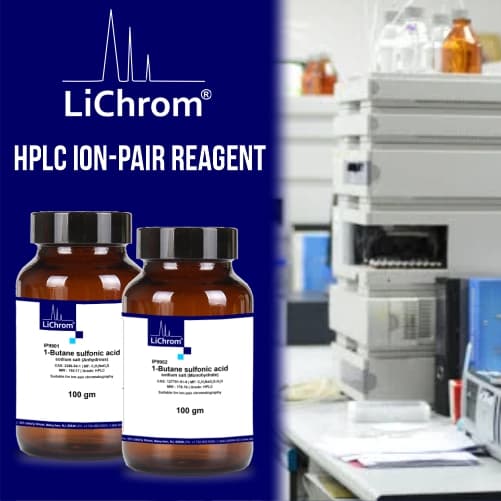
LiChrom offers a wide range of HPLC ion-pair reagents that are commonly used in HPLC analysis to improve the separation of charged analytes. Our product line includes options such as 1-Butane sulfonic acid sodium salt monohydrate HPLC, 1-Butanesulfonic acid sodium salt (Anhydrous) HPLC, 1-Decanesulfonic acid sodium salt (Anhydrous) HPLC, 1-Heptane sulfonic acid sodium salt (Anhydrous) HPLC, 1-Hexane sulfonic acid sodium salt (Anhydrous) HPLC, and more. These reagents work by forming ion pairs with the analytes, altering their interaction with the stationary phase to improve their retention and separation. Our high-quality HPLC ion-pair reagents are widely used in various industries for HPLC analysis. These products are essential for chromatographic separation techniques, providing increased retention and selectivity for ionic analytes, leading to more precise and accurate analyses in various scientific fields.
LiChrom Ion-pair reagents in HPLC are essential for improving the separation and analysis of ionic compounds in analysis of various fields. The various applications are as follows:
HPLC ion-pair reagents offer numerous benefits, enhancing the capabilities of high-performance liquid chromatography for the separation and analysis of ionic compounds. Here are some key benefits:

LiChrom brands meet the highest quality standards. LiChrom brand was founded with the vision of providing analyst, chemist, and all life science professionals with the best products available in the market.
If you are looking for consistent, reproducible, and dependable results then choose high-quality products from well recognized brands like " LiChrom". “LiChrom for HPLC have been recognized by many scientists, analyst, chemists, researchers, and scientific professionals in Pharmaceuticals, research laboratories, contract testing laboratories, universities where the critical analysis is required. LiChrom is exclusively distributed by Dawn Scientific Inc. LiChrom can be purchased online from www.dawnscientific.com or www.lichrom.com.