On Friday, September 19, 2025
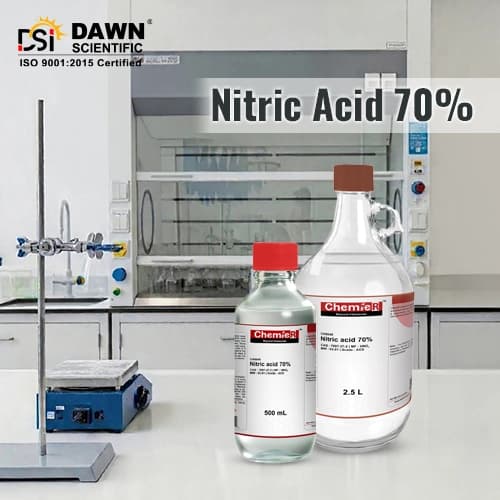
Nitric Acid 70% ACS is a highly valued strong mineral acid of high purity, and its excellent oxidizing power. Chemically hydrogen nitrate (HNO₃), Nitric Acid 70% ACS is a colorless or pale yellow liquid with a pungent, acrid odor. The ACS label guarantees the acid is up to the strict American Chemical Society’s standard for purity, making it suitable for high-precision laboratory, industrial, and manufacturing purposes.
In this article, we will be discussing what is Nitric Acid 70% ACS, its applications, advantages, shelf life, proper disposal, and where to buy high-quality nitric acid 70% ACS in USA.
Nitric Acid 70% ACS is a corrosive, concentrated acid with 70 weight percent anhydrous nitric acid and 30 weight percent water. In such a form, it contains the ability to trigger strong chemical reactions and is commonly find the application in high-reactivity uses. Its ACS grade naming guarantees that it is purified to be free of impurities, which makes it applicable for delicate industrial as well as laboratory purposes.
Alternate names:
Hydrogen Nitrate
Azotic Acid
Aqua fortis
If not treated appropriately, nitric acid can lead to serious burns, release deadly nitrogen dioxide fumes, and dissolve skin, metals, and organic matter. Proper laboratory safety practices have to be used.
Owing to its high quality and oxidizing power, Nitric Acid 70% ACS finds application in a broad range of applications in industries.
Nitric Acid 70% ACS (American Chemical Society grade) is a high-purity, strong oxidizing acid widely used in research, industrial, and analytical applications. Its ACS-grade certification guarantees that it achieves rigorous purity requirements, is qualified for demanding laboratory applications, and regulated environments. Some of its uses are:
Used for the digestion of samples in trace metal analysis.
Used for the preparation of analytical reagents in spectroscopy and chromatography.
Used as a powerful acid in pH control in accurate chemical processes.
Used as a nitrating agent for the synthesis of nitrated organic compounds and dyes.
Applied in pharmaceutical manufacturing for the production of active ingredients.
Used in demonstrations of acid-base chemistry.
Assists in oxidation-reduction experiments for chemistry students.
Used for etching and cleaning metals such as copper, brass, and stainless steel.
Used in aqua regia preparation (when combined with hydrochloric acid) for the dissolution of gold and platinum.
Involved in the passivation of stainless steel, stripping free iron off surfaces.
High Purity – Meets ACS requirements for minimal contamination
High Oxidizing Strength – Perfect for many chemical reactions
Reliable Performance – Delivers repeatable results in industrial and lab use
Versatility – Serves most industries from chemical to electronics
Efficiency – Supports high-yield reaction and clean processing outcomes
The shelf life of nitric acid is typically one to three years in the unopened container, based on storage conditions. Heat, light, and contamination can cause degradation to proceed more rapidly.
Unopened Bottles: Can be stored up to the full shelf life when properly kept in a dark, cool, and dry area.
Opened Bottles: Shorter shelf life due to exposure to air and possible contamination.
Container Material: Nitric acid is generally stored in corrosion-resistant high-density polyethylene (HDPE) bottles. Even HDPE, however, can age with time when exposed to abrasive acids, heat, and light.
For the longest life:
Keep tightly capped
Store out of direct heat and sunlight
Follow the printed expiration date by the manufacturer, which considers the stability of the chemical as well as the container integrity
Dispose of nitric acid properly to help prevent harm to individuals, property, and the environment.
Step-by-Step Disposal:
PPE Wear: Wear acid-resistant gloves, goggles, and a lab coat. Work in a fume hood.
Acid Dilution: Add nitric acid tow water to weaken.
Neutralize the Acid: Add a proper base like sodium hydroxide, calcium hydroxide, magnesium oxide, ammonia, or sodium bicarbonate to neutralize the solution to pH.
Test the pH: Test for neutrality using pH paper or a pH meter.
Dispose safely: Provided that it has been fully neutralized, the solution may drain-dispose under local environmental regulations. In all instances, call your local chemical waste official.
Never dispose of concentrated nitric acid down a drain—it is illegal where most people live and extremely dangerous.
When your inventory needs replenishing or expires, reorder from a qualified, certified vendor to achieve uniform quality and ACS compliance.
We at Dawn Scientific provide Nitric Acid 70% ACS in various sizes—from small lab packs to industrial bulk cases. Our nitric acid is manufactured and packaged under the firm control of quality for maintaining purity, reliability, and safe delivery. Online shopping is easy and convenient with small business and large plant options available.
Nitric Acid 70% ACS is a vital plant, research, and laboratory chemical. Its purity, strength as an oxidizer, and adaptability qualify it as the reagent of choice for the most demanding uses. Understanding how it’s used, its benefits, shelf life, and proper disposal methods enables you to work with it safely and efficiently in your workplace.
Buy from proven sources and practice adequate safety procedures to ensure optimal performance and safety.
Chemical production, metal refining, laboratory analysis, pharmaceuticals, and the semiconductor industry.
Generally, one to three years in an unopened container, depending on storage conditions. Opened containers have a finite shelf life.
Store in tightly closed HDPE container, apart from incompatible substances in a well-ventilated cool dark area.
No. Neutralize and dilute the nitric acid, and dispose of by local environmental guidelines.
You can buy it through certified suppliers such as Dawn Scientific that provide ACS-grade purity and consistent performance.
Disclaimer: All the information on this blog is published in good faith and for general information purposes only. The information contained in this blog might be provided on an “as is” based on Wikipedia, Google, and other scientific articles. We are not liable for any injuries or damages for the use of the information. Please do your research before you use this information for any purpose.