On Saturday, January 3, 2026
Ammonia is a very fundamental chemical in both world agriculture and world industry, and is highly utilized in fertilizers, cleaning agents, and chemical production. Nonetheless, its traditional manufacturing by the Haber-Bosch process involves very high temperatures and pressures and is thus one of the most energy-demanding chemical reactions, and a major cause of global greenhouse gases.
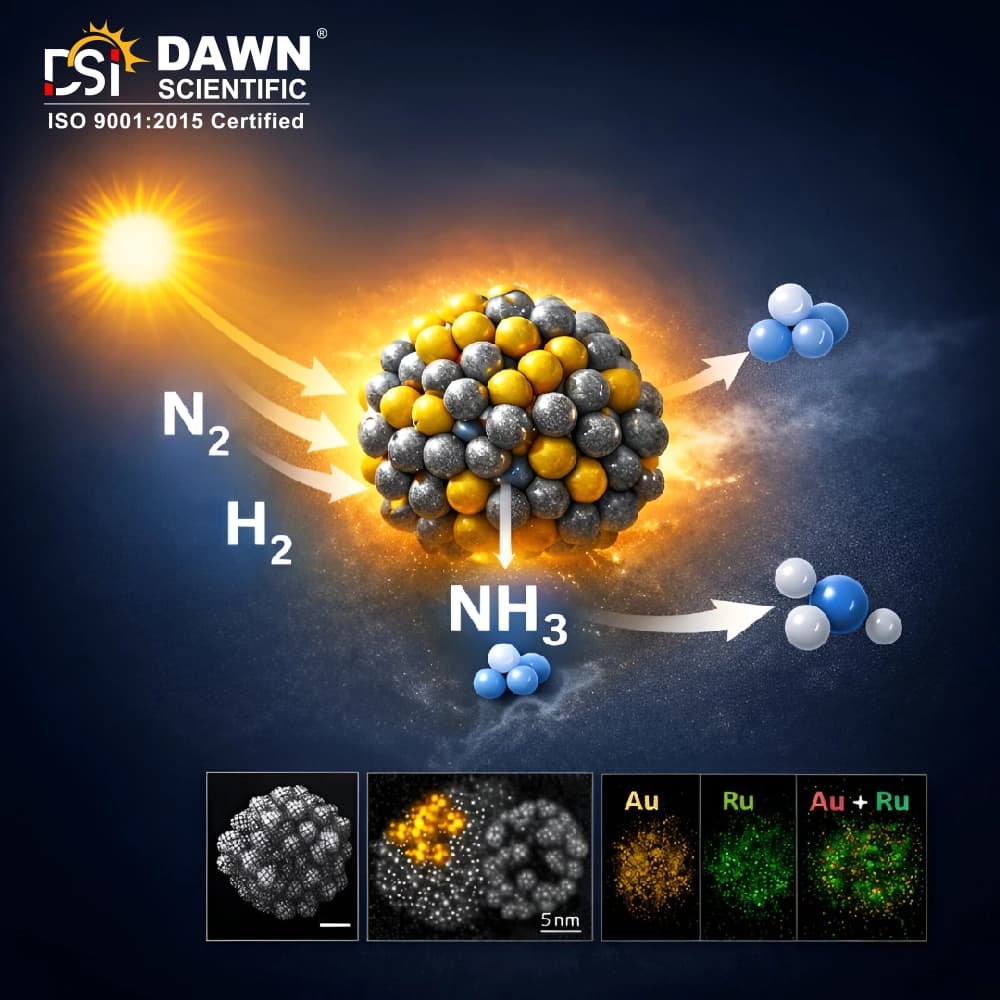
A new paper in Nature Energy cites a promising alternative: ammonia production by sunlight energy with the help of gold-ruthenium (AuRu) bimetallic nanoparticles. Those at Stanford University, Boston College, and other partnering institutions showed that these plasmonic nanoparticles can catalyze the reaction between nitrogen and hydrogen at room temperature and under normal atmospheric pressure when in the presence of visible light.
The AuRu nanoparticles are highly photoreactive and produce photoexcited electrons that speed up the important reaction processes. The researchers used in situ infrared spectroscopy to ensure that the light increases the rate of hydrogenation of nitrogen intermediates at a rate of about 60 μmol per gram of catalyst per hour of ammonia being produced. Computational modeling also showed this light-assisted process to be an associative hydrogenation process, similar to the natural process of fixation of nitrogen by biological enzymes.
This discovery emphasizes the possibility of photocatalysis to make the production of ammonia more sustainable and cleaner. Should such light-driven systems be successfully scaled, they would enable potentially significant reductions in the energy requirements and environmental impacts of ammonia synthesis, and provide new prospects for both industrial facilities and decentralized chemical synthesis.
Dawnscientific facilitates sustainable chemistry and materials research development by providing an all-encompassing assortment of laboratory reagents, lab consumables, and lab equipment. Through the provision of research-grade quality products that are accurate, safe, and reproducible, Dawn Scientific can help academic, industrial, and research labs enable innovation in energy-efficient and environmentally friendly chemical processes.
Disclaimer: All the information on this news is published in good faith and for general information purposes only. The information contained in this news might be provided on an “as is” based on Wikipedia, Google, and other scientific articles. We are not liable for any injuries or damages for the use of the information. Please do your own research before you use this information for any purpose.