On Saturday, January 24, 2026
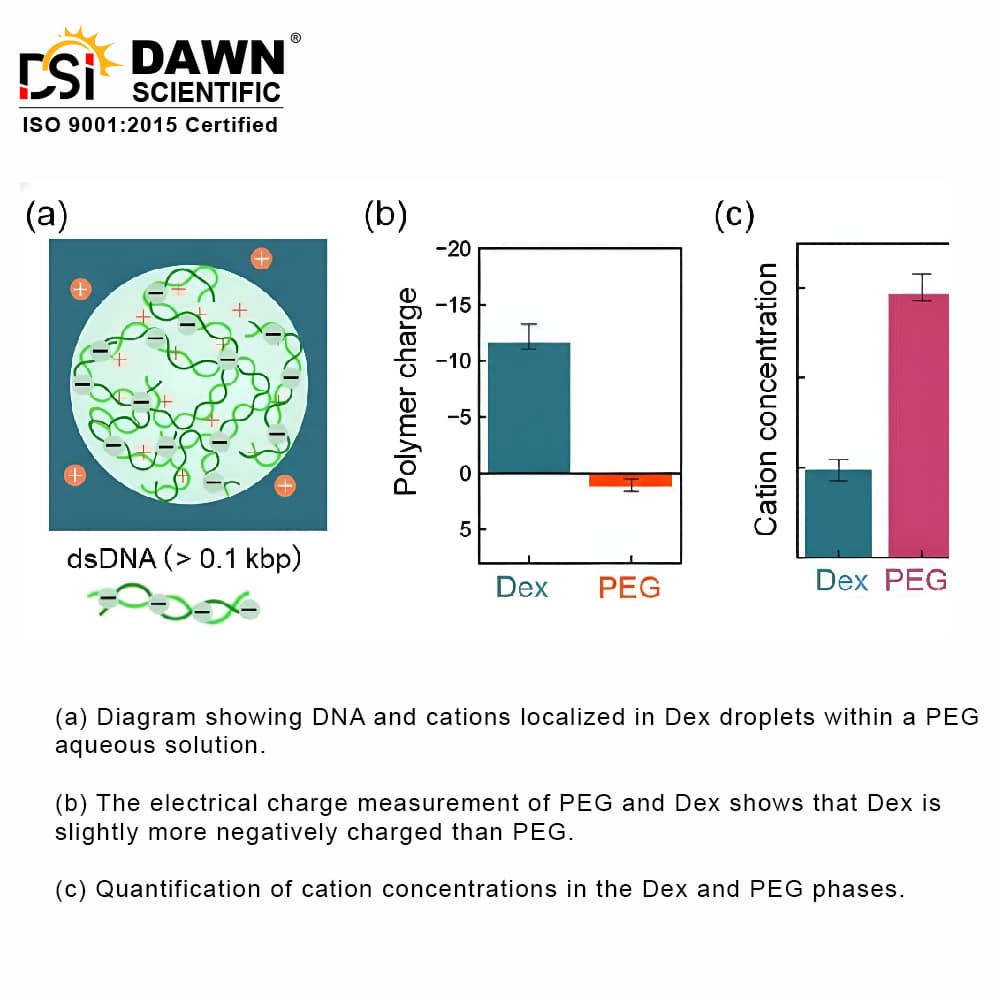
Scientists have identified a new physicochemical mechanism that explains how biomolecules localize in liquid–liquid phase separation systems, a process central to cellular organization and molecular biology. The research, published in ACS Macro Letters, shows that when a polymer solution separates into two coexisting liquid phases, dissolved ions do not distribute evenly. Rather, the accumulation of ions in phase-separated liquids affects the eventual location of charged biomolecules.
It was conducted by an international group of Miho Yanagisawa and Hiroki Sakuta of the University of Tokyo and Arash Nikoubashman of the Leibniz Institute of Polymer Research Dresden. The researchers studied the effects of the difference in electrical charges of polymer phases on molecular selectivity in biomolecular separation using a classic aqueous two-phase system (ATPS) of poly(ethylene glycol) (PEG) and dextran (Dex).
They found that the Dex-rich phase is a little more negatively charged than PEG-rich phase. Due to such an imbalance, the positively charged ions (cations) move into the Dex phase. This separation of cations in polymer solutions decreases the repulsive electrostatic force between negatively charged biomolecules like DNA to be concentrated in droplets of Dex-rich.
By using controlled experiments and ion sensitive fluorescent probes, the group demonstrated the first quantitative data of ion partitioning in liquid-liquid phase separation. This effect resembles Donnan equilibrium, previously associated mainly with gels and membranes, but now shown to operate in liquid biomolecular systems as well.
The liquid-liquid phase separation in cells is needed to make membrane-less compartments that organize biochemical reactions. It can also be applicable in the technologies of biomolecular separation and purification. This study contributes to the knowledge of phase separation in cells, polymer chemistry, and methods of analytical separation in the life sciences by revealing the role of ion distribution in the localization of biomolecules.
Dawn Scientific is a reliable provider of quality laboratory chemicals, reagents, and solutions to be used in research, testing and industrial applications. Dawn Scientific facilitates the work of scientists and other quality professionals with high accuracy, consistency, and compliance with its products that can lead to reproducible and meaningful results.
Disclaimer: All the information on this news is published in good faith and for general information purposes only. The information contained in this news might be provided on an “as is” based on Wikipedia, Google, and other scientific articles. We are not liable for any injuries or damages for the use of the information. Please do your own research before you use this information for any purpose.