
On Friday, October 10, 2025
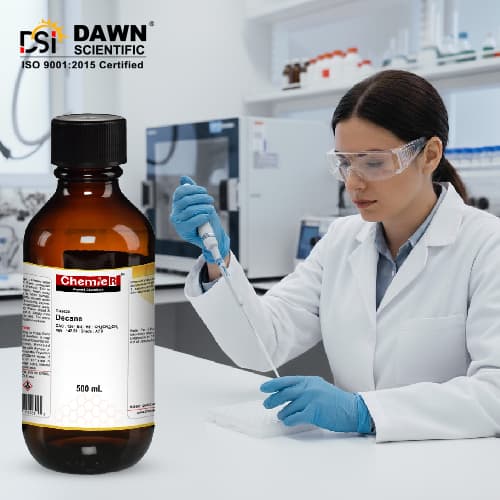
In scientific study and industrial use, chemical quality is a determinant of accuracy and reliability. To produce consistent and reliable results, whether in an analytical lab or manufacturing environment, is only possible by using ACS-certified chemicals. In this blog article, we are going to learn about the importance of ACS-certified reagents, their advantages, and how such chemicals enhance research quality, regulatory compliance, and laboratory safety.
ACS-certified chemicals are of superior purity reagents that will satisfy the high requirements of the American Chemical Society (ACS). They are rigorously tested for impurities and contaminants to ensure that they are good quality enough for vital laboratory and industrial uses. The ACS certification guarantees that a chemical meets the prescribed chemical purity standards or higher, hence ideal for accurate testing, analysis, and manufacturing purposes.
When a chemical is ACS certified, it undergoes extensive testing to ensure consistency and reliability. ACS certification makes it appropriate for research laboratories and industrial labs where high precision and reliability are needed in their experiments.
In research analysis, even the slightest change in the chemical content greatly affects the outcome. Chemicals accredited by ACS (American Chemical Society) guarantee experiment accuracy, whether performing titration, spectroscopy, or chromatography. The reagent purity directly contributes to the outcome of tests, particularly in pharmaceutical research companies, where even a slight impurity can lead to failure in the formulation of drugs or efficacy testing.
With ACS-recommended chemicals, you can be sure of research-grade chemicals such that the results of the experiments will be reproducible and reliable. The need for this reliability is best noted in the fields of pharmacy and medicine, where accuracy matters in the manufacturing of life-saving medications.
In industrial applications, such as pharmaceutical, chemical, and environmental testing, ACS-validated chemicals are of paramount importance in maintaining regulatory compliance and product quality. Pure ACS-certified chemicals are a critical factor in ensuring the quality and stability of drug production and manufacturing processes.
Contamination or heterogeneity in chemical content can lead to compliance issues, costly product recall, or even to consumer injury. Chemicals that meet the ACS standard guarantee critical industrial processes are conducted accurately and safely.
Consistency within the laboratory is needed in order to allow reproducible scientific information. ACS-certified reagents provide a condition where each batch of chemicals is of the same quality, eliminating any variability. From lab testing chemicals to reagents used in chemical analysis, to be an ACS-certified product is to stand for performance and accuracy.
In forensic science and environmental analysis applications where chemical purity testing is critical, trace contamination can produce false positives. High-purity ACS-certified chemicals guarantee reproducibility and reliability of test procedures and bring credibility to the results of research.
ACS-certified chemicals have a wide range of important advantages, especially when applied to business and science. Let us look at the general advantages:
One of the strongest arguments ACS-qualified research chemicals are in such high demand is that they have a guaranteed purity. Chemical purity standards are most crucial when doing analytical analysis. Small levels of contamination will have implications on the results of experiments, and due to this reason, ACS-certified chemicals are the best means of ensuring the integrity of your work.
ACS-certified chemicals of highest purity are tested for impurities rigorously such that only highest quality chemicals are utilized, which add more precision and reliability to research.
ACS-approved chemicals are also essential for compliance with stringent regulatory standards. Through the use of ACS-approved chemicals, laboratories and industrial plants can guarantee that they are conforming to these regulatory standards, thereby preventing penalties, product recall, or legal issues.
Safety is a key issue when handling chemicals. Low-quality chemicals could possess concealed or toxic impurities that threaten laboratory workers and customers. High-purity ACS-certified chemicals also undergo strict quality control processes to ensure their safety. This proves useful in industries like drugs, where the security of products is essential.
In industrial settings, ACS-certified chemicals play a vital role in maintaining effective manufacturing processes. Whether manufacturing pharmaceuticals or any other products, standard chemical composition is of primary importance. With ACS-certified chemicals, one can ensure maintaining quality and safety standards in products and adhering to industry requirements as well as consumers' expectations.
Selecting the proper ACS-certified chemicals is vital to the success of your experiments or production processes. Keep these points in mind:
Determine whether the chemical will be used for analysis, synthesis, or production.
Make sure that the chemical is of a required level of purity for your intended use, e.g., Product development, environmental monitoring, or chemical testing.
Choose a reliable supplier that provides pivotal documentation, such as Certificates of Analysis (COA) and Safety Data Sheets (SDS). Such documentation ensures conformity and verifies product quality.
Though ACS-certified chemicals cost more, the extra costs involved are worth it as they are accurate, reliable, and regulatory compliant. Buy from suppliers who offer bulk rates to maintain costs low.
Are you looking for where to buy ACS-certified chemicals for industrial applications? Upon purchasing high-purity ACS-certified chemicals, one must purchase them from a reputable vendor such as Dawn Scientific. We provide extensive offerings of ACS-certified reagents and applications, and also provides the documentation to prove product quality and authenticity.
ACS-certified reagents are extremely crucial in assuring accuracy, compliance with regulations, and safety in industrial and analytical labs. They are as pure and uniform to a very high level and are suited to drug discovery, research, and virtually all industrial uses. ACS-graded reagents allow labs to decrease the danger of contamination, guarantee consistent operation, and meet the rigorous standards imposed by regulatory agencies.
ACS-certified chemicals ensure accuracy and reliability with demanding purity requirements, the secret to reproducibility.
Opt for application needs, purity, and supplier quality when making a choice on ACS-certified research reagents.
Yes, but they're worth the added expense because of their purity, stability, and regulatory acceptability.
There is also a reliable supplier like Dawn Scientific, which offers a vast range of ACS-certified chemicals for research and industrial use.
Request the supplier for a Certificate of Analysis (COA) and Safety Data Sheets (SDS) to confirm ACS certification.
Disclaimer: All the information on this blog is published in good faith and for general information purposes only. The information contained in this blog might be provided on an “as is” based on Wikipedia, Google, and other scientific articles. We are not liable for any injuries or damages for the use of the information. Please do your research before you use this information for any purpose.