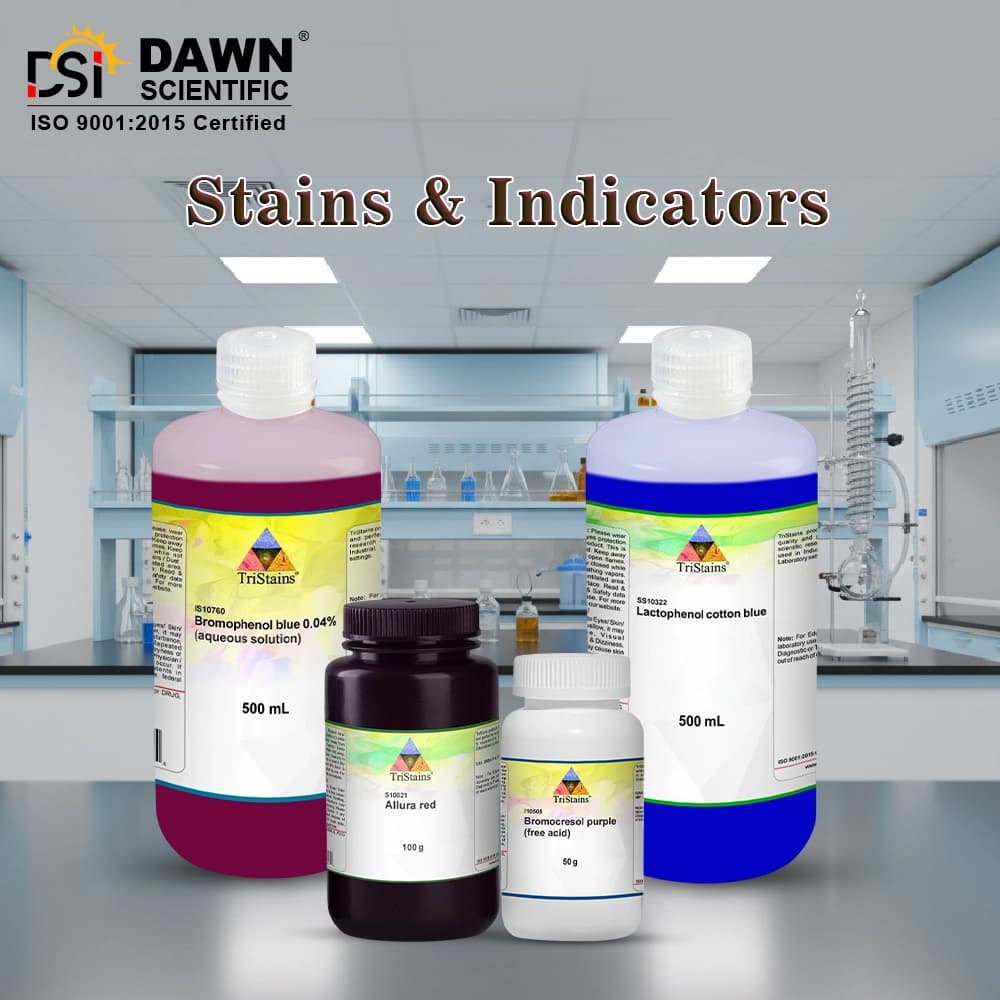
In the modern high-level scientific world environment, it is important
that a laboratory obtains accuracy, precision, and reproducibility.
stains
and
indicators
are one of the reagents that invariably facilitate this objective.
stains
and
indicators
are used in microbiology, histology, chemistry, pharmaceuticals, and
environmental science to give the clarity and degree of measurements
that can be used to produce reliable scientific data.
With the current trend of automation, digital microscopy, and high-level
analysis testing in the different laboratories in the United States, the
significance of the correct usage of the
stains
and
indicators
has never been as important as it is today. Here, we examine their
types, uses, advantages, and where to buy
stains
and
indicators
in the USA to do research and industrial purposes.
What Are Stains and Indicators?
stains
and
indicators
are special chemical reagents that are used to identify structures,
identify reactions, or quantify changes in a sample.
stains
are attached to cells, tissues, microorganisms, or compounds and are
viewed under a microscope.
indicators
are used as color changes to identify the change of pH, endpoints of
titration, or reaction progress.
These powerful tools contribute greatly to the performance of the
laboratories, particularly during the assessment of the types of
stains
and
indicators
used in laboratories the field of microbiology, histology, chemistry,
and environmental testing.
Types of Stains and Indicators Used in Laboratories
Modern laboratories cannot perform effectively without various groups of
indicators
and
stains. All types have a distinct role to play in coming up with valid
scientific inferences.
1.Microbiology Stains to identify and diagnose.
It is important to note that microbiology
stains
are needed to identify and distinguish microorganisms during
clinical and research practice. They allow a clear picture and
are used to diagnose infections in a short time.
Microbiological stains used include:
-
Gram Stain- Identifies Gram-negative organisms and
Gram-positive organisms.
-
Acid-Fast Stain - It is used in the detection of Mycobacterium
species.
-
Lactophenol Cotton Blue- Highlights fungal structures.
-
Methylene Blue - This is good for the screening of microbes.
The basis of routine diagnostic procedures is these laboratory
stains.
2. Tissue and Cell Imaging histology Stains.
The
histology stains
are extremely important in diagnostics as they show the
morphology of the tissue and the pathological alterations.
The most common
histology stains
stains are:
-
H&E (Hematoxylin & Eosin) - The basic tissue morphological
stain.
-
Giemsa Stain -Determines blood parasites and cell types.
-
Congo Red - Identifies amyloid in tissues.
-
Wright Stain- Hematology and bone marrow.
These
stains
are the best
stains
and indicators for scientific research, particularly in
pathology laboratories.
3. Essays on Indicators Chemical: Analytical and Industrial.
Most
chemical indicators
find application in pharmaceutical laboratories, chemical
quality control, scholarly studies, and manufacturing.
-
Phenolphthalein- universal titration indicator.
-
Methyl Orange- Sensitive to low PH.
-
Bromothymol Blue - it is applied in biochemical analysis.
-
Starch indicator – it is vital during titrations involving
iodometry.
These
lab indicators
make sure that there is accuracy in the titrations, environment
monitoring, and testing of production quality.
4. pH indicators of Rapid Chemical Analysis.
A significant type of
chemical indicators
is the pH indicator, which is used to quickly determine acidity
and alkalinity.
Common examples:
- Litmus solution
- Phenol Red
- Universal Indicator
These PH
indicators
play an important role in water analysis, biochemistry, and
industrial analysis.
5. Analytical Stains for Research and Forensic Science
Certain staining agents are applied in special uses and thus are
very useful analytical
stains.
Examples include:
-
Sudan III & IV - Assay fats in tissues and food.
-
Silver Nitrate- This is employed in the development of
fingerprints in forensics.
-
Alizarin Red S -Identifies calcium deposition.
These are the best instances of how
stains
and
indicators
improve laboratory accuracy in high-level research settings.
Uses of Stains and Indicators in the Modern Laboratory.
The application of the
stains
and
indicators
is spread across several fields of science, which makes the results
reliable and measurable.
1. Microbiology Laboratories
-
Identification of bacteria, fungi, and parasites.
-
The visualization of antibiotic sensitivity.
-
Screening of the microbial environment.
The appropriate microbiology
stains
result in accuracy and a quicker outcome.
2. Histology and Pathology
-
Reconstruction of tissue structure visualization.
- Cytology evaluations
-
Identification of abnormal cell patterns.
In this case, the
histology stains
aid clinicians in identifying the precise cause of the disease.
3. Chemical and industrial Laboratories.
- Acid-base titrations
- Industrial QC testing
- pH monitoring in wastewater
- Analysis of chemical formulation.
Laboratory
indicators
and chemical
indicators
of high quality make compliance and safety possible.
4. Pharmaceutical and Research Laboratories.
- Cell culture studies
- Toxicity testing
- Matter compatibility investigations.
At this point, analytical
stains
can be of extreme value.
5. Food and Environmental Testing.
- Contamination detection
- Water quality analysis
- Soil and mineral testing
- Food adulteration testing.
Such procedures illustrate ways in which the
stains
and
indicators
enhance laboratory accuracy in real-life scenarios.
Advantages of High-Quality Stains and Indicators.
The selection of the appropriate
stains
and
indicators
has several benefits:
- High purity guarantees that there is minimal interference.
- Deep, solid color saturation.
- Accurate response measurement.
- Fewer errors and increased reproducibility
- Stability and increased shelf life.
-
Best suited to controlled sectors like the pharmaceuticals and the
healthcare labs.
That is why it is important to choose the best
stains
and
indicators
for scientific research to guarantee that the results are consistent and
valid.
Where to buy stains and indicators in the USA
To have a good laboratory performance, it is necessary to find good
products. When you are asking yourself where to buy
stains
and
indicators
in the USA, Dawn Scientific can present a wide collection of:
-
Microbiology stains
-
Histology stains
-
Analytical stains
-
pH indicators
-
Chemical indicators
-
Indicators and research, and industry laboratory stains.
Dawn Scientific offers quality, quantity, and quick delivery with brands
such as TriStains, which are trusted.
Why Choose Dawn Scientific?
- Laboratory pure chemicals
- Bulk and custom packaging
- Affordable pricing
- Expert technical support
- Fast nationwide shipping
-
There is so much to explore at
DawnScientific.com
Frequently Asked Questions about Stains and Indicators.
Disclaimer: All the information on this blog is published in good faith
and for general information purposes only. The information contained in
this blog might be provided on an “as is” based on Wikipedia, Google,
and other scientific articles. We are not liable for any injuries or
damages for the use of the information. Please do your research before
you use this information for any purpose.