
On Friday, June 20, 2025
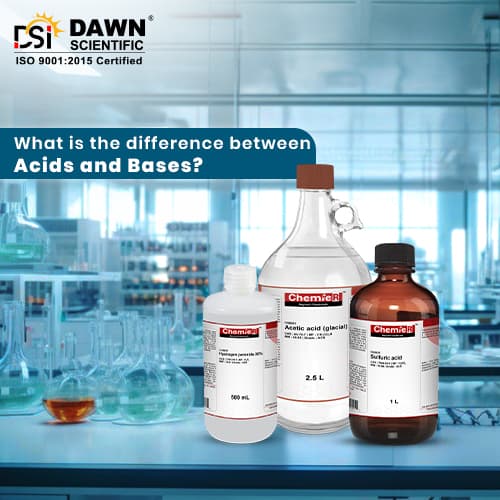
Acids and bases are basic concepts of chemistry that affect everything from school science classes to consumer goods. If you’re working with lab chemicals or learning about basic science, the knowledge of the difference between acids and bases is essential.
In this detailed guide, we’ll break down the properties, examples, and scientific significance of acids and bases . By the end of this article, you’ll understand how to distinguish between acidic and basic substances, how the pH scale works, and why it matters in practical applications.
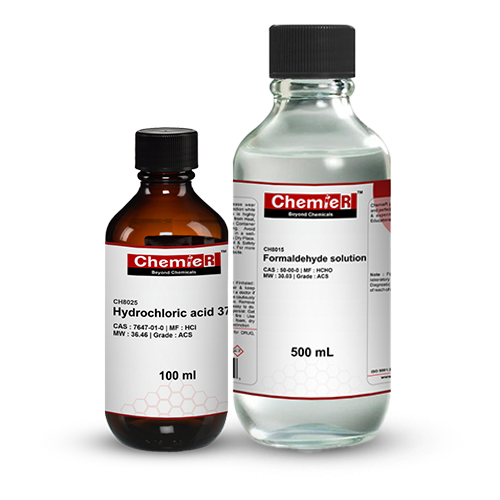
Chemical Acids are chemicals which dissociate to provide hydrogen ions (H⁺) in water. This is at the core of their acidity in solutions, especially in acid-base reactions.
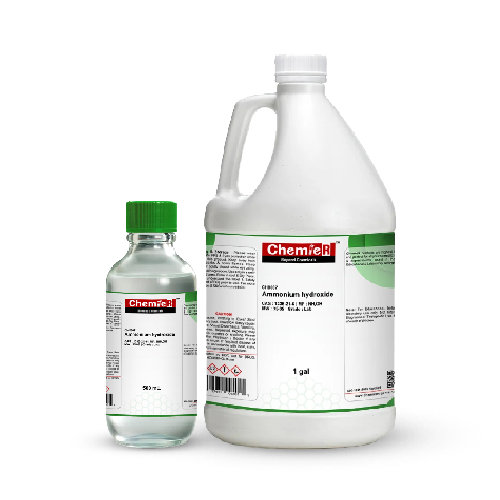
Bases are chemicals that accept hydrogen ions or release hydroxide ions (OH⁻) when dissolved in aqueous solution. Alternatively referred to as alkalis if water-soluble, bases possess distinct characteristics compared to acids.
Here’s a side-by-side table of the difference between Acids and bases :
| Feature | Acids | Bases |
| Ion Released | H⁺ | OH⁻ |
| pH Range | 0–6.9 | 7.1–14 |
| Taste | Sour | Bitter |
| Litmus Reaction | Turns blue red | Turns red blue |
| Feel | Corrosive | Slippery |
| Reaction with Metals | Yes (produces H₂) | No |
| Common Examples | HCl, H₂SO₄, Vinegar | NaOH, Ammonia, Soap |
This table points out the defining traits and enables easy differentiation.
The pH scale is a numbering system from 0 to 14 on which the acidity or alkalinity of a solution is assessed.
The scale is logarithmic such that each whole number represents a tenfold variation in the H⁺ concentration. A solution with pH 3, for example, is ten times more acidic than one with pH 4.
Scientific pH measurement is essential in research, production, and education. We provide a variety of pH indicators, test strips, and electronic pH meters for accurate measurements.
Perhaps the most important chemical reaction is the acid-base neutralization reaction:
Acid + Base → Salt + Water
Example:
HCl + NaOH → NaCl + H₂O
This reaction forms the basis of some of the most important applications in the fields of environmental science (water purification), medicine (antacids), and laboratory chemistry.
Learning about Acids and bases is not just for school purposes—there are many everyday uses:
Food: Citric acid in sodas and sweets
Pharmaceuticals: Aspirin manufacturing uses salicylic acid
Industrial Applications: Sulfuric acid in fertilizers and oil refining
Acids and bases can be hazardous. Careful identification, storage, and PPE (Personal Protective Equipment) need to be employed.
Acids and bases are different in chemical properties, pH, and chemical reaction on dissolution. Both are also incredibly crucial to scientific knowledge and progress, from biological function to industrial chemistry.
We at Dawn Scientific are committed to offering science professionals and educators better chemicals, technical assistance, and service. If you teach first-year chemistry or run a research lab, learning the nature of acids and bases is the beginning of conducting proper and safe experimentation.